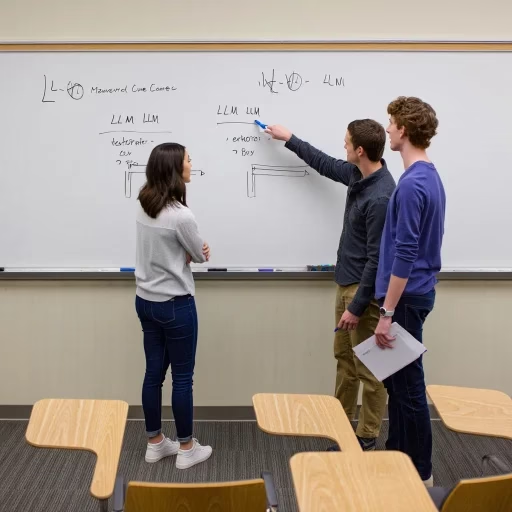
MIT team teaches AI models what they didn't know yet.
The application of artificial intelligence (AI) is growing rapidly and becoming increasingly intertwined with our daily lives and high‑stakes industries such as healthcare, telecommunications, and energy. But with great power comes great responsibility: AI systems sometimes make mistakes or provide uncertain answers that can have major consequences.
Why is this so important?
Many AI models, even advanced ones, can sometimes exhibit so‑called ‘hallucinations’—they produce erroneous or unfounded answers. In sectors where decisions carry heavy weight, such as medical diagnosis or autonomous driving, this can have disastrous consequences. Themis AI developed Capsa, a platform that applies uncertainty quantification: it measures and quantifies the uncertainty of AI output in a detailed and reliable manner.
How does it work?
By imparting uncertainty awareness to models, they can equip outputs with a risk or confidence label. For example, a self‑driving car can indicate that it is uncertain about a situation and therefore trigger human intervention. This not only enhances safety but also increases users’ trust in AI systems.
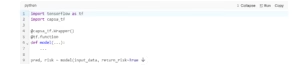
- When integrating with PyTorch, wrapping the model via
capsa_torch.wrapper()where the output consists of both the prediction and the risk:

For NetCare and its clients, this technology represents a huge step forward. We can deliver AI applications that are not only intelligent but also safe and more predictable, with a lower chance of hallucinations. It helps organizations make better‑substantiated decisions and reduce risks when deploying AI in mission‑critical applications.
Conclusion
The MIT Team Shows that the future of AI is not only about becoming smarter, but especially about functioning more safely and fairly. At NetCare we believe that AI only becomes truly valuable when it is transparent about its own limitations. With advanced uncertainty quantification tools such as Capsa, you can also put that vision into practice.


