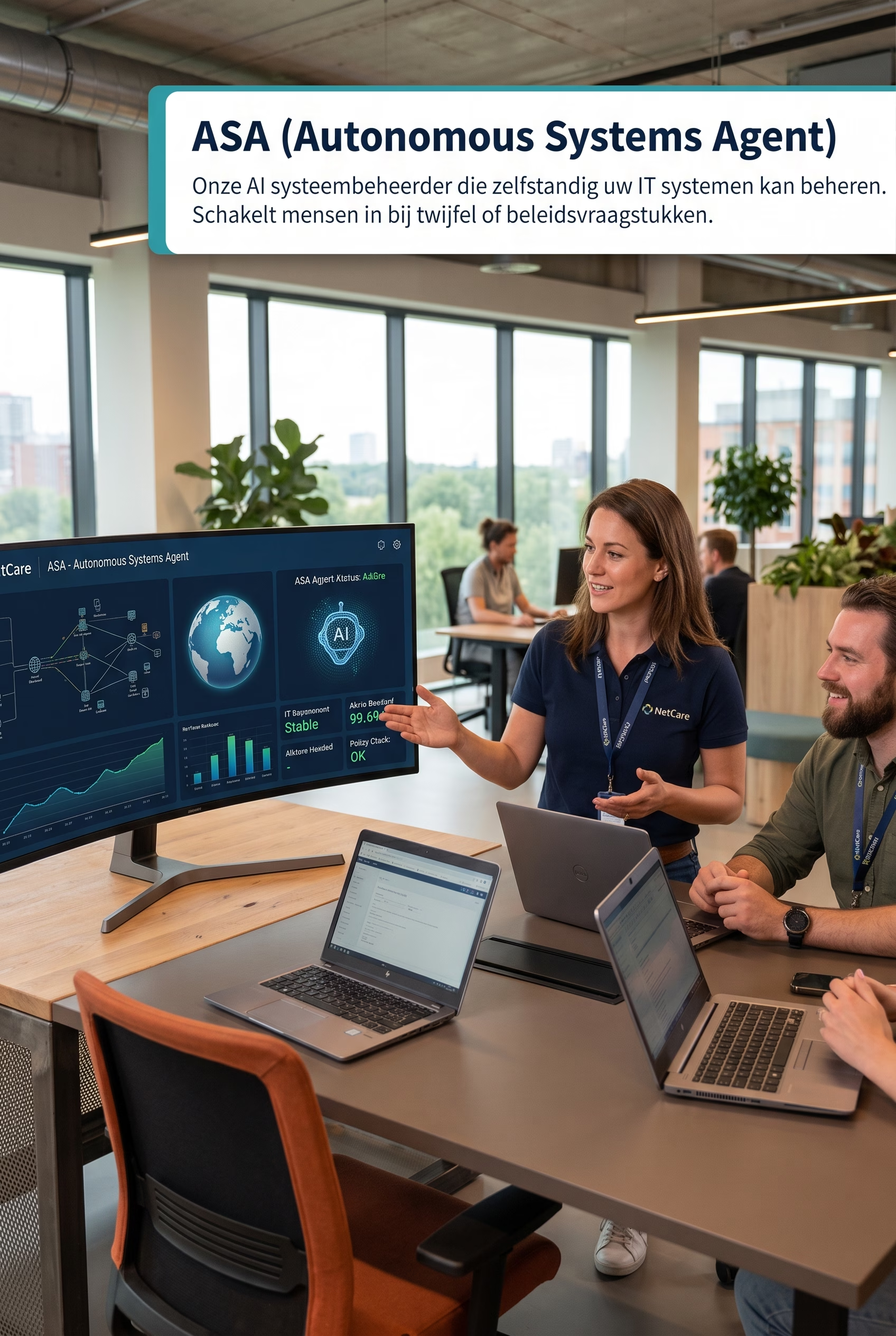
ASA is our AI system administrator. Independent of vendors, designed so it cannot be hacked through its own tools.
What is ASA?
Most “AI management tools” sold today come from your own provider—and are therefore, by definition, tailored to their products. If you choose best-of-breed IT (the best servers, the best storage, the best network equipment—even when it comes from different brands—often the most sensible choice economically and technically), you end up with just as many separate, non-communicating AI layers.
ASA is different. It’s a proprietary, vendor-independent AI system administrator that is given knowledge of your IT environment—not trained, but configured, the way you would onboard a new administrator. One layer across your entire IT landscape, regardless of which brands are involved.
Why ASA?
Independent of vendors No lock-in to a single brand’s AI tooling. ASA works across your full best-of-breed IT landscape—exactly the architecture principle that major players try to build node by node, now available for the SMB market. Even the model itself can be selected and adapted as newer or cheaper models become available.
Secured by design, not as an afterthought ASA autonomously manages your infrastructure and software layer—disk space, patch status, uptime, database health—without ever getting access to ticketing systems, email, or other sources of untrusted text. This isn’t carelessness; it’s intentional design: it closes the exact gap where AI agents worldwide most often get stuck (prompt injection). If you want ASA to proactively resolve issues based on tickets, we put a human administrator in the loop—not for convenience, but only when the risk truly increases. At the first login in the morning, ASA may or may not ask the human administrator.
Lower costs, higher uptime, fewer incidents A large share of all data breaches worldwide comes from vulnerabilities that had a patch available long ago, but were simply applied too late. ASA eliminates that delay permanently: continuous monitoring, a clear separation between functional updates (wait calmly until a release has proven itself) and security updates (rolled out extremely quickly and in phases), with automatic rollback as soon as something turns out not to be compatible.
Key features
- 🔓 Vendor-independent — works alongside and between hardware and software from different vendors; no lock-in
- 🧠 Environment-specific knowledge, no training — ASA is onboarded in your environment, just like a new colleague, and expands that knowledge as your environment grows
- 📡 No access to untrusted content — no tickets, no email, so no prompt-injection risk at the most vulnerable point of every AI agent
- ⚙️ Fixed, policy-based skills — a clear distinction between functional and security updates, each with its own scheduling and testing regime
- ↩️ Automated rollback — in case of an outage or an integration issue between two vendors, the change is rolled back and reported, so it can be investigated in a test environment
- 👤 Human-in-the-loop where it matters — routine management fully autonomous; exceptions and issue resolution always with a human in the loop
- 📉 Minimal maintenance effort after setup — once set up correctly the management of the AI layer itself stays to a minimum
- 🔍 Sensitive to creeping errors — detection based on deviations from its own historical baseline, not only on hard outages
How it works
- Intake — we map your current IT landscape: which vendors, which integrations, which risks
- Knowledge transfer — ASA is onboarded to your specific environment: topology, runbooks, policies
- Document policies — together we define the fixed skills: patch policies, rollback thresholds, escalation paths.
- Autonomous start — ASA takes over daily management: monitoring, patching, health checks
- Human escalation — If there’s any doubt, or for an incident or a request to resolve issues, ASA brings in a system administrator.
- Ongoing optimization — As your environment grows, we expand the configuration — no redesign, just regular maintenance you can also do yourself using the included tools.
Who is ASA for?
ASA was developed specifically for the SMB (Small and Medium-Sized Businesses)companies that want the benefits of professional, continuous IT management—comparable to what large enterprises achieve with their own SOC and platform teams—but don’t have the people or budget to set that up themselves.
- SMEs without their own large IT department
- Organizations with a best-of-breed IT landscape (multiple vendors side by side)
- Companies that are vulnerable to delayed patching but don’t have a team available to provide 24/7 security coverage
- Growing businesses that want to prevent their IT landscape from becoming cluttered with legacy systems
Frequently asked questions
Is it secure enough for critical systems? Yes—precisely because ASA deliberately has no access to tickets, email, or other untrusted text sources, it misses the attack surface (prompt injection) that causes most AI agent incidents worldwide. For tasks that do introduce that risk, we place a human between ASA and the execution.
Does ASA work with the vendors we already use? Almost always. ASA is intentionally built to be vendor-independent — it doesn’t replace your servers, storage, or network equipment, but manages them regardless of brand.
What happens if ASA applies an update that turns out not to work? Then ASA automatically rolls back the change and reports the incident, so it can be investigated in a test environment — never blindly push it through.
Does ASA replace our IT staff member or supplier? No. ASA takes over the routine, time-consuming management work — patching, monitoring, health checks — so your people (or Netcare, if we’re engaged as a service provider) can focus on what humans do best: complex issues, architectural decisions, and exceptions. So it really does save time and costs. The AI also has broad knowledge of various products, which reduces the need to hire external expertise.
How quickly is ASA operational? That depends on the size and complexity of your IT landscape. After the intake and knowledge transfer, ASA can quickly take on the first low-risk tasks autonomously; we build additional permissions in phases, as trust — and track record — proves itself.
Get started
Curious whether ASA fits your IT landscape? Get touch in for an obligation-free conversation.
Working together on a better digital future.


