The AI Design Authority
We are at a turning point in software development. The discussion is often about which whether AI writes the best code (Claude vs. ChatGPT) or where where that AI should reside (IDE or CLI). But that is not the right question.
The problem is not the generate of code. It is the validation of it.
If we embrace AI as “Vibe Coders” – where we provide the intention and the AI handles the execution – we create an enormous flow of new software. A swarm of AI agents can generate more code in one minute than a senior developer can review in a week. Humans have become the bottleneck.
The solution is not more people. The solution is an AI Design Authority.
From Craftsman to Factory Director
Traditionally, the “Design Authority” is a small group of architects who meet once a week or month to approve or reject a design. In a world of high-velocity AI development that model is hopelessly outdated. It is too slow and too reactive.
If we switch to “Disposable Code” – software that we do not endlessly refactor, but discard and regenerate when requirements change – then our role fundamentally changes. We are no longer masons laying brick by brick. We are the architects of the factory that prints the walls.
But who checks if those walls are straight?
The “Gauntlet”: An Automated Trial by Fire
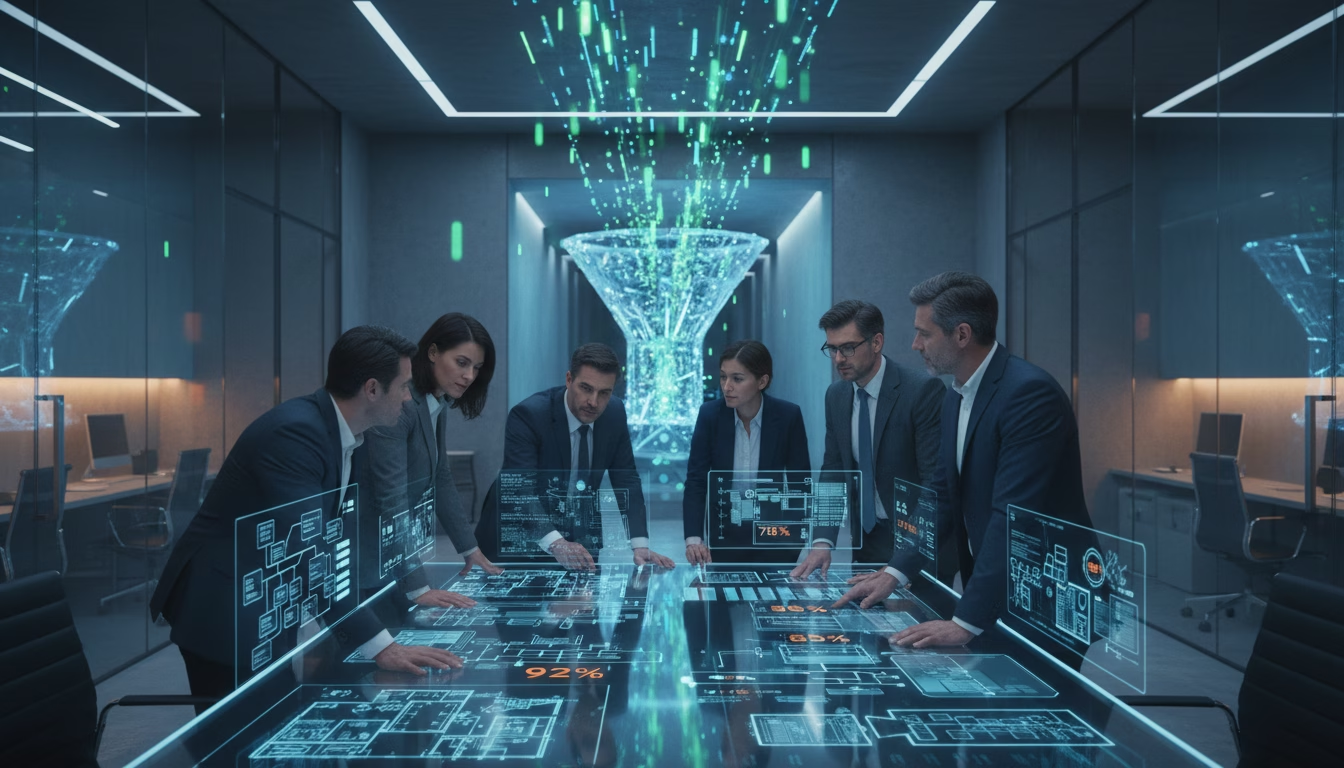
An AI Design Authority is not a person, but a pipeline. A “Gauntlet” that every line of generated code must fight through to reach production. This process does not replace human code review with nothing, but with something better.
It works in three layers:
1. The Executive Power (The Generation)
We don't ask one AI for a solution; we ask three. We have Gemini 3, GPT-5, and an open-source model (like Llama) work in parallel on the same problem. This prevents tunnel vision and breaks through the 'laziness' that LLMs sometimes suffer from. This approach is also scientifically researched and demonstrates that you can prevent AI hallucination and build very long chains without errors
2. The Hard Filter (The Law)
There is no room for discussion here. Code must compile. Linters must not complain. And crucially: the Black Box Tests must pass. We do not test if the function works internally (that allows the AI to be manipulated); we test whether the system does what it is supposed to do from the outside. Does the test fail? Straight into the trash.
3. The Soft Filter (The AI Jury)
This is the real innovation. The remaining solutions are presented to a specialized “Voting AI”. This agent does not write code, but reads code. He is trained on our architectural principles, security requirements (OWASP, ISO), and compliance rules (EU AI Act).
He states: "Solution A is faster, but Solution B is safer and better adheres to our microservices architecture."
The winner moves to production.
The Trias Politica of Software
This model enforces a separation of powers that is missing in many teams.
- The Legislative Power (The Architect): The Architect writes the “Constitution”. The prompts, the architecture documents (
project-description.md, rules.md, skills.md en principles.md), the strict requirements. The architect determines what what we build, who builds it, how and why. - The Executive Power (The Coding Agents): They execute. Fast, cheap, and under the auspices of human developers.
- The Judicial Power (The Design Authority): An independent AI layer that tests against the law.
Conclusion: The New Role of the Architect
It frees us from the tyranny of syntax errors and allows us to focus on what we are good at: Systems thinking. Truth finding. Structure and decision-making.
The question is not whether AI can write our code. That topic is already settled. Code is largely becoming a disposable product.
The question is: Do you dare to take control of the code to release, thereby regaining control over the quality to win back?
let me know


