
Cybersecurity and the Architecture of the Future
Artificial intelligence is rapidly transforming the IT landscape. While many organizations are focusing on productivity gains and eliminating manual work, a more fundamental transformation is taking place in the background: an asymmetric race against time in cybersecurity.
The urgency is clear: organizations that fail to adapt their security and architecture to this pace will be driven out of the market by cyber incidents or the inability to obtain insurance. To understand and manage this transformation, we need to examine the three successive waves of the AI security challenge—and the architecture required to remain resilient.
The Three Waves of the AI Security Transformation
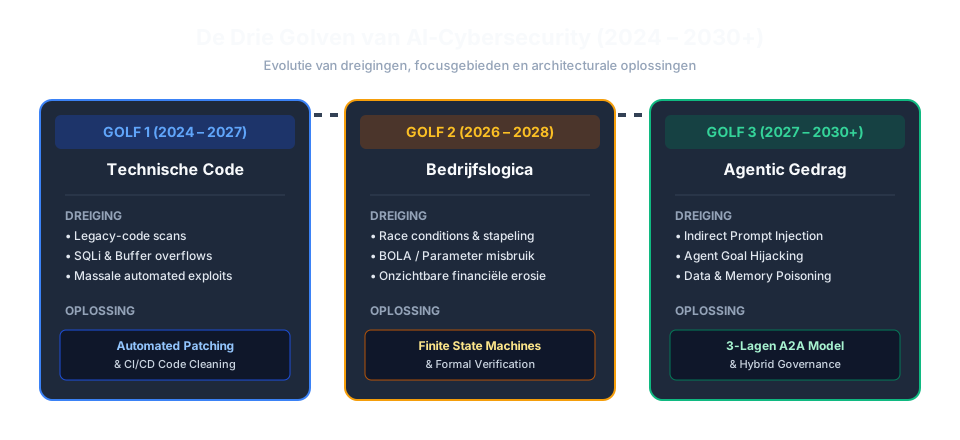
Wave 1: Technical Vulnerabilities in Code (2025–2027)
-
The problem: The current explosion in data breaches and break-ins is the result of a historic catch-up effort. AI tools are scrutinizing decades of human-written legacy code. Classic flaws—such as SQL injections, memory leaks, and outdated libraries—are being discovered by attackers at scale.
-
The dynamic: This phase focuses on ‘Shift Left’ and automated code hygiene. Companies that clean up their pipelines and equip them with automated tests and patches can make their traditional codebases more secure than ever, quickly.
-
The solution: Continuous automated patching and code cleanup. CI/CD pipelines are being equipped with AI gatekeepers that continuously scan codebases, automatically generate patches, and deploy them once integration tests have passed.
Wave 2: Exploitation of Business Logic (2026–2028)
-
The problem: Once the technical front door is secured, the battle shifts to the functional logic. An API may be 100% secure from a technical perspective—free of SQL injection or buffer overflows—but if a user or script can influence the system through a specific sequence of actions, such as race conditions in discounts, BOLA manipulations, or skipping process steps, this results in immediate financial damage.
-
The dynamic: Attackers no longer break the system; they make the system operate in a way that costs the organization money. This leads to continuous, invisible erosion of margins.
-
The solution: Formal Verification & Strict Finite-State Machines (FSMs).
-
Finite-state machines (FSMs): Business processes are not written as separate API endpoints, but mathematically modeled as a closed finite-state machine. The system can only move from state A (
CART_CREATED) to state B (PAYMENT_PENDING) and C (ORDER_COMPLETED). Manipulating or skipping steps is made technically impossible at the server level. -
Idempotency and Atomic Transactions: Actions are made idempotent and processed using strict database isolation levels. Race conditions (submitting multiple requests simultaneously to stack discounts) are automatically blocked or queued at the database level.
-
AI-assisted formal verification: AI agents are deployed in the build pipeline to use mathematical verification to prove ensure that the software can assume only the intended logical states, even before the code goes into production.
-
Wave 3: Manipulation of AI Agents and Decision-Making (2027–2030+)
-
The problem: In a full-agentic world, autonomous AI agents work together and make decisions based on data from the outside world (emails, invoices, documents). At this stage, attackers target Indirect prompt injection, Data Poisoning and the takeover of agent goals.
-
The dynamic: The source code and logic are correct, but the AI agent is misled by the context it reads. The question shifts from “Is the code secure?” to “Is the agent’s decision-making reliable?”.
-
The solution: The Three-Layer A2A Communication Model (Agent-to-Agent).
The Architecture Solution for Wave 3: The Three-Layer A2A Model
To enable AI agents to negotiate flexibly about complex situations and edge cases without exposing the organization to the risks of Wave 3, a layered communication architecture is essential. The principle is simple: negotiate in natural language, but execute through a formal contract.

The three layers of the A2A architecture:
Layer 1: The Free Negotiation Layer (Expression & Creativity)
Here, agents communicate with each other in a rich context to explore complex issues, prices, and conditions.
-
The risk: This is the layer most vulnerable to influence, prompt injection, and manipulation.
-
The safeguard: At this layer, agents may no direct action whatsoever execute in the production infrastructure. It is an isolated sandbox. In addition, we protect this layer with Cognitive rate limiting (preventing an agent from probing parameters without limitation) and Cross-model validation (a second, differently trained AI model assesses the negotiation outcome for manipulation).
Layer 2: The Formalization and Intent Layer (Legal Safeguarding)
As soon as agents in Layer 1 reach agreement on a solution or transaction, the outcome is stripped of all free-form language and narrative.
-
The safeguard: The result is converted into a formal, structured contract (using a Domain-Specific Language or an established JSON schema). This explicitly defines the obligations, limits, and conditions. This layer acts as the digital ‘notary’ that checks whether the proposal complies with the predefined business frameworks.
Layer 3: The Deterministic Execution Layer (The Immutable Foundation)
This is the level at which the actual transaction or system change is implemented. No AI agents communicate here anymore; instead, rigid mathematical systems communicate through the monitored logic from Wave 2.
-
The safeguard:
-
Cryptographic Verification: Messages between systems are secured via Mutual TLS (mTLS), equipped with unique nonces (to prevent replay attacks), and signed with cryptographic keys.
-
Deterministic Gateways: API gateways verify, without AI intervention, whether a request falls within the strict limits (such as a maximum transaction amount).
-
The New Role of Human Experts
This layered approach shows that the role of human specialists does not disappear but shifts toward defining the system’s frameworks:
-
The Procurement Officer designs the strategies, parameters, and boundaries within which the agent in Layer 1 is allowed to negotiate.
-
The Legal Counsel designs the templates, ontologies, and formal logical frameworks for Layer 2.
-
The Security Architect builds the deterministic, monitored execution environment in Layer 3 and safeguards the FSM logic from Wave 2.
By strictly separating the “thinking and negotiation phase” from the “execution phase,” we retain the flexibility of AI agents while ensuring that control over business operations remains firmly in the hands of the organization.
Need help with the transformation to AI-driven cybersecurity and automation? Get in touch today contact to


